Voices Behind the Glass XII
- Roots of Humanity Foundation

- Apr 9
- 5 min read
An Inside Look at the Sphere of Light from One of Its Visionary Creators
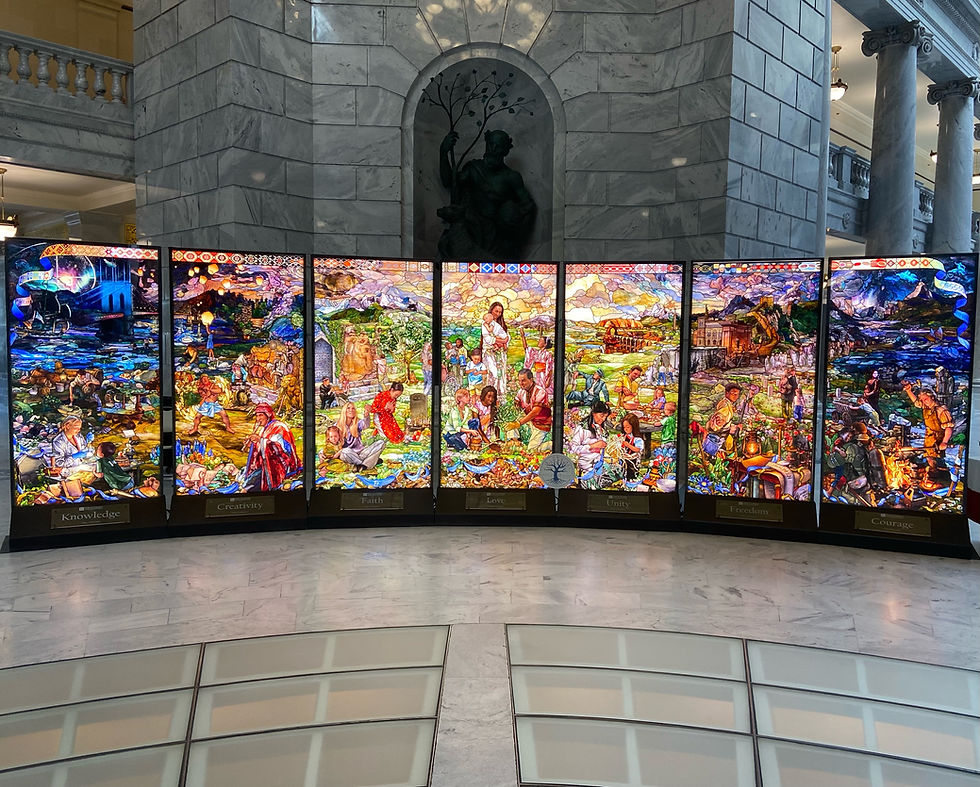
Welcome back to our Artist Interview Series, where each month we spotlight one of the talented artists bringing the Sphere of Light to life. Today we’re excited to introduce Peter Kemp who is one of the key glass pickers & artists helping to craft this center for good.
About the Artist
Can you share a bit about your background and how you got started in stained glass? My name is Peter Kemp. I have been working at Holdman Studios for a little over three and a half years now. I have a bit of a background in woodworking, along with different types of design work and painting as hobbies, but nothing too serious.
I got started in stained glass shortly after I began working here. It was kind of a turning point in my life. I decided to quit my previous job and look for something different, and I saw that Holdman Studios was hiring. I applied, and they told me they would teach me how to work with stained glass. They said it should be fun, and that was it.
How is working with woodworking compared to stained glass? Did having a background in woodworking help? Woodworking is a little more forgiving in a lot of ways than thin glass. Glass is obviously an extremely fragile medium. If you make a bad cut on glass, you usually have to replace the entire piece. With wood, you can sometimes work around mistakes by filling, gluing, or carving pieces so they blend better. It is not always ideal, but it gives you more flexibility.
Glass also has more of a free flowing quality compared to woodworking, which often requires extremely precise measurements. I like that handmade feel that glass has. Having any kind of experience crafting with your hands really helps with stained glass, especially when working with lead caming. You have to think ahead and plan how the window will be assembled. Whether it is woodworking, sculpting, or anything where you are building something, learning to anticipate the next steps makes a big difference.
What inspires your artistic style and approach to working with glass? It is purely emotional, honestly. That is interesting because I do not really consider myself a very emotional person, at least outwardly. Sometimes it is hard for me to convey emotion, but when I look at a window design and understand what we are aiming for, I will go through pieces of glass and feel it out. At some point, it reaches a balance for me, and I think that is the piece that looks right.
Most of the time, it works out pretty well. When it does not, it is usually because I felt conflicted when choosing the glass. Sometimes it becomes a trust the process situation where I choose something for now, even if I am not fully confident, and then come back to it later to see if it still feels right.
Do you have a favorite technique or part of the process? Glass selection is probably my favorite part. It involves more problem solving and really scratches that creative itch. Cutting and building can become a bit repetitive once you get into a flow, but selecting glass requires more thought. You have to consider how the light will come through it, how it affects the pieces next to it, and how everything works together.
If a piece is too opaque, even if it is the right color, it can end up looking like a black hole. Solving those kinds of challenges is something I really enjoy.
About the Sphere of Light
What challenges have you faced while working on this project? One of the biggest challenges comes when selecting glass for designs that do not immediately feel cohesive or that I am not particularly passionate about. Sometimes designs are more like rough ideas rather than clearly defined plans, which leaves a lot open to interpretation.
Designers may have a very specific vision in mind, and it can be difficult for them to explain it or for me to fully understand it when choosing glass. That is usually where challenges come up. Communication helps a lot though. When a window looks right, it is hard to explain exactly why, but everyone can feel it. Once we all reach that point, we know it is finished.
What is it like working with other artists on a project like this? It mostly comes down to communication and patience. After working with someone for a while, you start to understand how each other thinks and works. Sometimes it is even easier when two people already understand the direction and a third person joins in.
I am not always the best at explaining ideas, but if someone else on the team is better at that, they can help translate the vision to others. Everyone thinks differently, so it is really about taking the time to find a balance together.
Personal Connection and Impact
What does it mean to you to be part of the Sphere of Light project? It feels good to be part of something that will be impactful, even if that impact is still far in the future. It is motivating to remember that this project will eventually reach a lot of people. It can be easy to get caught up in the daily tasks and challenges, but the bigger goal is to express emotion. Whether that leads to a life changing experience or just a moment where someone thinks this is really neat, it all matters. Knowing that this work can touch people’s lives is exciting and really rewarding.
What emotions or messages do you hope people take away from the Sphere of Light? I think it is exciting to highlight glass as an art medium outside of traditional architecture. There have not been many impactful glass art projects since the time of Tiffany. Showing what glass can do and what is possible with it is really important to me.
Beyond that, the design of the Sphere of Light aims to convey unity and the shared experience of humanity. I hope people feel a sense of togetherness and gratitude toward humanity as a whole. The experience will be personal for everyone, but overall, I hope it leaves people feeling connected to those around them.
If you could describe the Sphere of Light in three words, what would they be?Magnificent, wholeness, and togetherness.
Don't forget to join us next month for another full Artist Interview Series!
Best,
Roots of Humanity


Comments